Bitcoin Price Analysis and My Long-Term Investment Strategy
In this article, I share my Bitcoin investment strategy, recent BTC purchases, and future buying plans. My goal is not to predict short-term price movements but to systematically build a Bitcoin position using a disciplined capital allocation strategy.
Bitcoin – Summary of My Recent Purchases and Investment Strategy
In this post, I summarize my recent Bitcoin purchases and explain the core principles behind my investment strategy.
To fully understand my approach, I recommend reviewing all previous videos and posts related to each cryptocurrency I currently invest in. In every piece of content, I provide information such as:
- The current market price
- The price range I am monitoring
- My planned buying levels
- The percentage of capital allocated to each purchase
This information will later be used to calculate average purchase prices and potential profits when positions are sold.
Current Cryptocurrency Portfolio (June 8, 2026)
As of June 8, 2026, I am actively investing in:
- Bitcoin (BTC)
- Ethereum (ETH)
- XRP
- Solana (SOL)
- Bitcoin Cash (BCH)
- Aster
- Linea
- Bittensor (TAO)
Bitcoin Price Analysis Videos
Bitcoin Current Price: $77,400
Trading Range: $35,000 – $124,000
Bitcoin Current Price: $71,700
Trading Range: $35,000 – $124,000
Bitcoin Current Price: $66,500
Trading Range: $35,000 – $124,000
Bitcoin Current Price: $60,000
Trading Range: $35,000 – $124,000
Why I Don’t Use Leverage Trading
One of the most important parts of my investment strategy is avoiding leverage.
Many traders are attracted by the possibility of making fast profits through leveraged trading. While leverage can amplify gains, it also dramatically increases risk and can quickly lead to significant losses.
I prefer a long-term wealth-building approach based on:
- Risk management
- Capital preservation
- Gradual portfolio growth
- Consistent investing
- Emotional discipline
In my opinion, financial freedom is achieved through patience and consistency rather than speculation.
Young investors especially have a significant advantage: time.
Investing steadily over 10, 20, or 30 years can potentially create substantial wealth while avoiding unnecessary risks.
My Bitcoin Accumulation Strategy
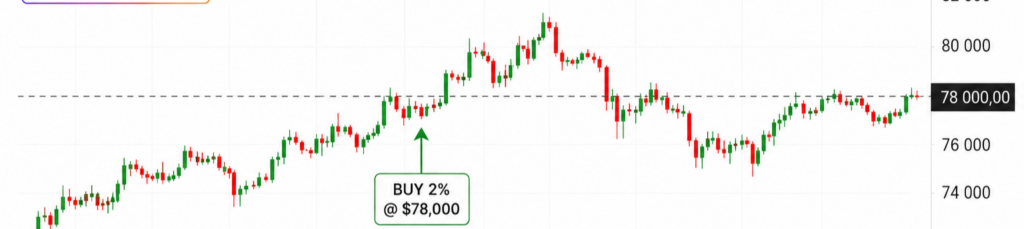
Bitcoin Purchase
BTC Price: $78,000
Capital Allocation: 2% of total capital allocated to Bitcoin
Bitcoin Purchase
BTC Price: $72,000
Capital Allocation: 2% of total capital allocated to Bitcoin

Bitcoin Purchase
BTC Price: $66,000
Capital Allocation: 2% of total capital allocated to Bitcoin
Bitcoin Purchase
BTC Price: $60,000
Capital Allocation: 5% of total capital allocated to Bitcoin
Planned Bitcoin Purchase
BTC Price: $55,000
Capital Allocation: 5% of total capital allocated to Bitcoin
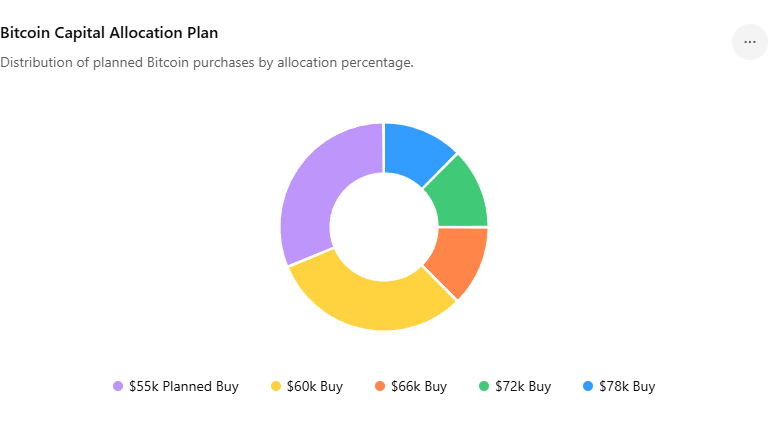
Bitcoin Buying Plan Summary
| Bitcoin Price | Portfolio Allocation |
|---|---|
| $78,000 | 2% |
| $72,000 | 2% |
| $66,000 | 2% |
| $60,000 | 5% |
| $55,000 | 5% (planned) |
If all planned purchases are executed, a total of 16% of the capital allocated to Bitcoin will be invested.
Long-Term Bitcoin Investing
This Bitcoin strategy is designed for investors who want to build positions gradually during market fluctuations instead of trying to predict exact tops and bottoms.
My focus is on:
✅ Bitcoin accumulation
✅ Risk management
✅ Long-term investing
✅ Wealth creation
✅ Financial freedom
✅ Portfolio growth
✅ Avoiding leverage
✅ Consistent execution
The objective is simple: accumulate quality assets over time and allow compounding and market growth to work in my favor.
Keywords
Bitcoin investment strategy, Bitcoin price prediction, Bitcoin accumulation, BTC buying strategy, Bitcoin DCA strategy, cryptocurrency investing, long-term Bitcoin investing, Bitcoin portfolio, Bitcoin analysis 2026, Bitcoin market cycle, financial freedom, wealth building, risk management, crypto investing strategy, Bitcoin bull market, Bitcoin bear market, BTC investment plan.
Disclaimer
This content is for educational and informational purposes only and should not be considered financial advice. Always conduct your own research and make investment decisions based on your personal financial situation and risk tolerance.
Leave a Reply